In a world where efficiency is paramount, building owners and architects are often turning to innovative solutions to reduce costs and the environmental impact their building has on its community. Onsite water reuse systems can offer not just environmental benefits but also significant return on investment (ROI) and cost savings over time.
When Epic Cleantec engages with new projects about the desire to include onsite water reuse systems in the design, the first few questions we encounter are typically about the ROI and costs associated with reuse technology. For every project, we conduct a free assessment that includes a water balance to determine the impact a reuse system can have, both financially and through water savings. In this assessment we examine the project’s location, size, program, and goals. We also identify any available incentives or grants for the location that can help offset initial capital investment. Learn more about how we determine if onsite water reuse is right for a project.
Key Takeaways
- Onsite water reuse systems can help building owners reduce water and sewer costs by recycling wastewater for non-potable uses like irrigation, toilet flushing, and cooling systems.
- Project ROI depends on factors like location, building size, water use, local utility rates, regulations, incentives, and system design.
- Onsite water reuse systems can typically achieve ROI in 3–7 years, while helping projects reduce exposure to rising water and sewer rates.
- In addition to direct cost savings, onsite water reuse can support regulatory compliance, green building goals, LEED certification, and long-term water resilience.
The ROI of onsite water reuse
There are many factors that will make a difference in a system’s ROI, including regulations, market fit and more. Epic’s solutions offer a predictable and often lower cost for water compared to traditional municipal supply, with ROI achieved in 3-7 years. This is particularly compelling as water and sewer rates across the country have outpaced inflation by nearly 300% over the last two decades.

Example of ROI payback period for greywater or blackwater onsite reuse system vs. municipal supply only
Below are few other advantages you can expect from implementing an onsite water reuse system in your next project:
- Reduced water costs: The most immediate benefit of onsite water reuse systems is a substantial reduction of freshwater entering the building, resulting in lower water bills for the building owner. Epic’s OneWaterTM system reuses 50-95% of a building’s wastewater for non-potable purposes such as irrigation, toilet flushing, or cooling systems, lowering the demand for new fresh water supply and leading to cost savings over time.
- Mitigation of sewage fees: Municipalities charge sewer fees based on the volume of water discharged into the centralized sewer system. By reusing water onsite, less water is discharged, further contributing to cost savings and improved financial efficiency.
- Regulatory compliance: Many regions are imposing stricter regulations and fees related to water usage and disposal. San Francisco’s onsite reuse ordinance and Austin’s GoPurple program are examples of these initiatives. Investing in onsite water reuse helps owners comply with these regulations and also prevents them from potential fines and penalties.
- Conservation rebates and incentives: To the opposite effect, many regions offer rebates, incentives, or grants to encourage water conservation practices. Epic Cleantec will help projects take advantage of these funding opportunities to further reduce the initial capital investment required for implementing water reuse technologies.
- Resilience to water supply challenges: Water scarcity and water quality issues are becoming increasingly prevalent in many regions due to factors such as population growth, climate change, and aging infrastructure. Building owners and developers can mitigate risks associated with water supply disruptions by implementing water reuse systems, ensuring a reliable onsite water source.
- Energy savings: Onsite water treatment and recycling often require less energy compared to centralized water treatment plants. This leads to reduced energy costs and a smaller carbon footprint, aligning with broader sustainability goals.
- LEED and Green Building certifications: Incorporating water reuse systems into building designs can contribute to achieving Leadership in Energy and Environmental Design (LEED) or other green building certifications. Epic’s full resource recovery solution can earn projects up to 25 LEED points.
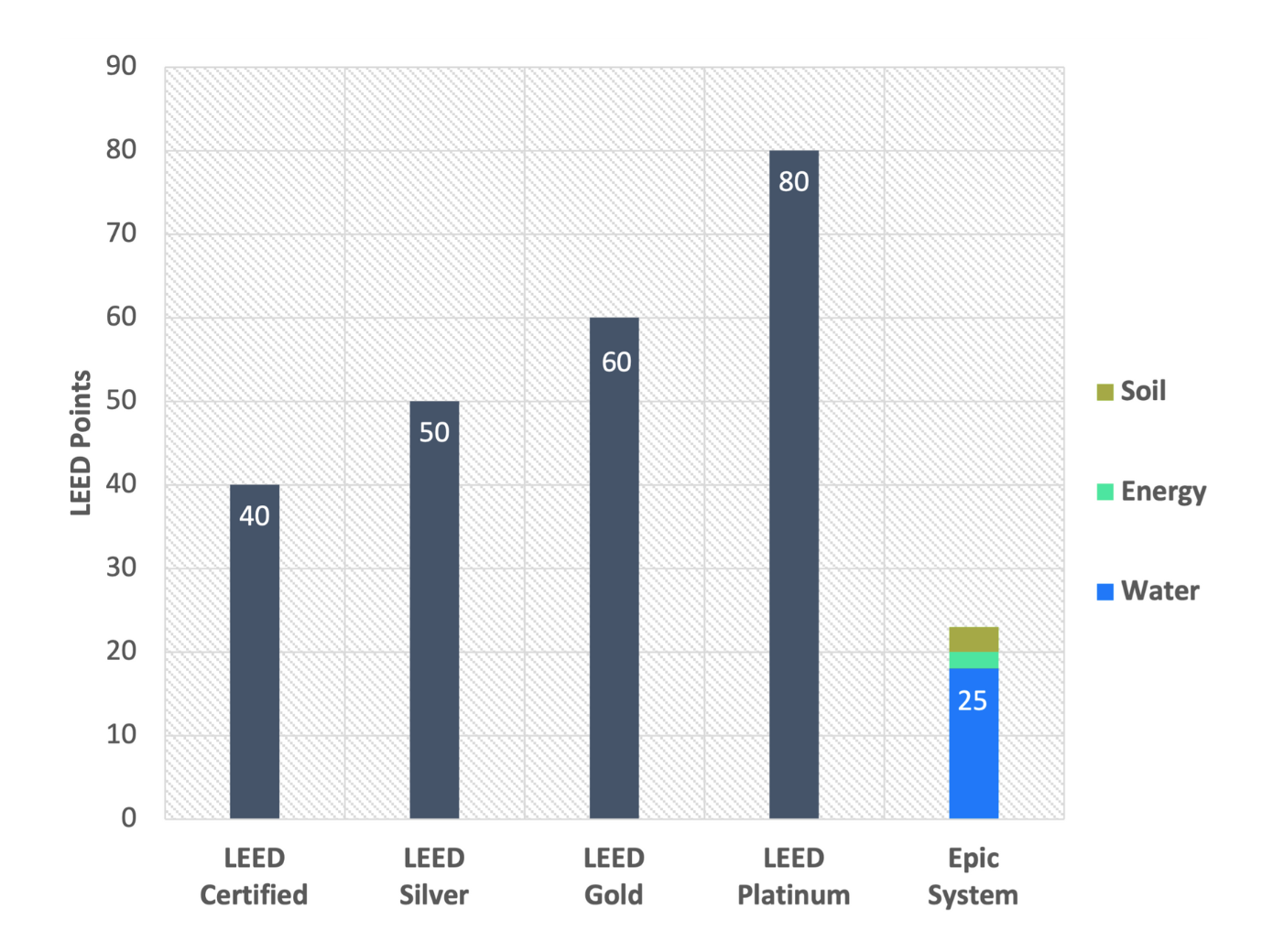
Graph of possible LEED points available through Epic’s water reuse, solids capture and heat recovery solutions
Example ROI calculation for an onsite water recycling system
Actual costs and payback periods vary by building size, local utility rates, wastewater volume, system design, incentives, and annual maintenance needs. However, a worked example can help show how a water recycling system can generate long-term savings.
For this example, assume a commercial building installs an onsite water recycling system to treat and reuse wastewater for non-potable applications such as toilet flushing, irrigation, and cooling.
Assumptions:
- Annual building water use: 10,000,000 gallons
- Percentage of water reused onsite: 60%
- Reused water volume: 6,000,000 gallons per year
- Combined water and sewer rate: $0.035 per gallon
- Estimated annual gross utility savings: 6,000,000 gallons x $0.035 = $210,000
- Estimated annual operating and maintenance cost: $60,000
- Net annual savings: $210,000 – $60,000 = $150,000
- Estimated installed system cost: $750,000
Payback calculation:
$750,000 installed cost ÷ $150,000 net annual savings = 5 years
In this scenario, the building would recover the upfront cost of the water recycling system in approximately five years. After that payback period, the system could continue generating net savings each year while helping the property reduce demand for municipal water, lower sewer discharge costs, and improve long-term water resilience.
This example is illustrative only. A project-specific assessment will be better able to provide your building’s actual water balance, local utility rates, permitting requirements, available incentives, and planned reuse applications.
Other benefits and long-term effects of an onsite water reuse system
- Enhanced property value: Sustainability initiatives and eco-friendly practices are increasingly influencing property valuations. Properties equipped with efficient water reuse systems enhance the building’s sustainability credentials and are seen as more attractive to environmentally conscious investors. In fact, 34% of the population is willing to pay more for sustainable products or services.
- Risk mitigation: Investing in water reuse infrastructure provides long-term cost stability by reducing the dependence on external water sources that come with the risk of fluctuating municipal water rates. Onsite water reuse systems offer a degree of independence and resilience, mitigating these risks and ensuring continuity of operations.
- Potential for marketing and branding: Building owners and developers can leverage their investment in water reuse as a marketing tool to differentiate their properties in the market. Highlighting sustainable practices such as water reuse can be used to appeal to potential tenants, investors, and residents who prioritize environmental responsibility.
Success stories in action
Epic has seen all types of projects reap the benefits of water reuse, from multifamily to hospitality and commercial office spaces. Here are a few examples:
- Fifteen Fifty: This 40-story luxury apartment building is home to the first permitted and approved onsite greywater operation in San Francisco’s city history. Operated and maintained by Epic, the onsite water reuse system has the capacity to recycle 7,500 gallons of greywater per day (or over 2.5 million gallons per year) and will save Related more than $90,000 annually on utility costs over the next 10 years.
- Salesforce Tower: This 61-story office building located in San Francisco is home to the largest onsite blackwater system in a commercial high-rise in the U.S., designed to recycle up to 30,000 gallons of wastewater per day. It will reuse 7.8 million gallons of freshwater per year and save $395,000 in utility fees annually.
- Waldorf Astoria: The award-winning Waldorf Astoria hotel located in Beverly Hills, CA will reuse over 438,000 gallons of water per year for use in landscaping with Epic Cleantec’s OneWaterTM system. Although it has a smaller daily reuse capacity of 1,200 gallons per day, it will still save hotel owners nearly $10,000 in utility fees annually.
Invest in sustainability and savings with a water recycling system
Onsite water reuse systems represent a paradigm shift in water management, offering tangible financial benefits alongside environmental stewardship. The initial investment in these systems can be countered by the long-term ROI, cost savings, and strategic advantages they bring. As projects navigate the challenges of resource scarcity and regulatory pressures, embracing water reuse technologies is not just a prudent choice but a strategic imperative for sustainable growth and competitiveness.
Learn more about our solutions and get in touch with Epic Cleantec today!
Frequently asked questions about the ROI of a water recycling system
- What are the annual operating costs of a water recycling system?
- Annual operating costs vary by system size, local jurisdiction testing requirements, monitoring needs, preventative maintenance plans, and more. Epic Cleantec can provide you with a custom plan that works for your budget. Reach out to our O&M team to get a quote for your building’s needs.
- How long does it take for a water recycling system to pay for itself?
- Payback depends on project-specific factors such as utility rates, system capacity, water demand, available incentives, and local regulations. Projects can achieve ROI in 3–7 years, especially in areas where water and sewer rates are high (or rising). Learn more about NOI and payback.
- What factors have the biggest impact on water recycling system ROI?
- The biggest ROI drivers include the amount of water a building can reuse, local water and sewer rates, available rebates or grants, system design, operating costs, and the building’s non-potable water demand. Larger buildings with consistent water use, such as multifamily, hospitality, and commercial office properties, may see stronger long-term savings. Learn more about the ROI of water reuse.
- Can a water recycling system deliver savings beyond utility bills?
- Yes. In addition to reducing water and sewer costs, onsite water reuse can support regulatory compliance, improve resilience during water supply challenges, contribute to LEED or green building certification, and strengthen a property’s sustainability profile. Projects that incorporate our full suite of resource recovery solutions (water reuse, heat recovery and soil) can earn up to 25 LEED points. Connect with Epic to learn more about achieving LEED points in your next project.